
Nebraska has a child care crisis. Looming Medicaid cuts will worsen it.
The Congressional Budget Office estimated that almost 5.2 million adults will lose Medicaid coverage and be uninsured by 2034
 By News Channel Nebraska
Malissie Plugge holds her daughters, Violet, 2, left, and Margo, 5, at their Omaha home. Photo by Rebecca S. Gratz for the Flatwater Free Press
By Destiny Herbers
Flatwater Free Press
Malissie Plugge felt blessed to find the perfect child care setup for her daughters Margo and Violet, a warm, sweet in-home day care not too far from their home in Omaha.
Over the past year and a half, the woman who ran the day care became like family. Plugge planned to keep sending her girls, ages 5 and 2, until they both started school.
But in January, the provider learned her mother’s home health nurse would no longer be covered by Medicaid due to state funding cuts. The day care had to close so she could take care of her mom.
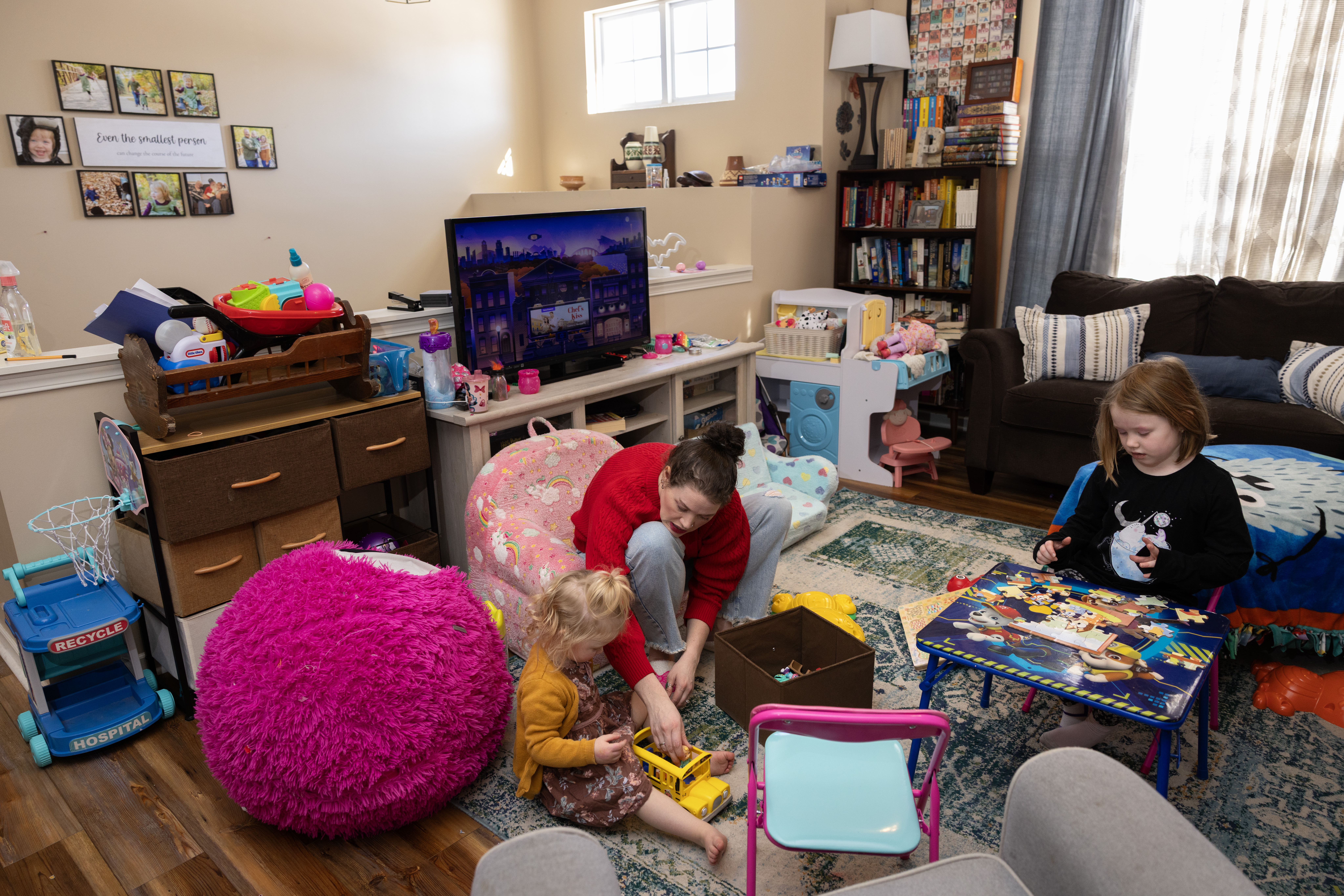
Malissie Plugge plays with her daughters, Violet, 2, left, and Margo, 5, at their home in Omaha. Photo by Rebecca S. Gratz for the Flatwater Free Press
“It's so hard to find a good day care that you feel super safe and comfortable with … we've all just been really sad,” Plugge said. “The kids have cried about it. I've cried about it. She's cried about it.”
The Plugge family won’t be the only one in this situation soon. An estimated 1 in 8 child care workers in Nebraska are using Medicaid, according to a Flatwater Free Press analysis of data from the U.S. Census Bureau’s American Community Survey Public Use Microdata Sample.
It’s an essential support for an industry where workers tend to be underpaid and lack benefits, experts said. That support is slated to be slashed under President Donald Trump’s 2025 tax and spending bill, often called “the One Big Beautiful Bill.”
The Congressional Budget Office estimated that almost 5.2 million adults will lose Medicaid coverage and be uninsured by 2034 as a result of those cuts, which will hit states at the beginning of 2027. Nationally, about 40 million adults are enrolled in Medicaid, which means about 13% are expected to lose their health insurance coverage.
About 228 Nebraska child care providers could lose coverage, according to a Flatwater analysis based on federal estimates and the number of Nebraska child care workers enrolled in Medicaid.
Nebraska already has a critical shortage of child care workers. Since 2019, the state has lost almost 30% of those workers, according to American Community Survey data.
And that impacts families. The Buffett Early Childhood Institute estimates that around 16,310 children in Nebraska currently need care, but their families cannot reasonably access that care within driving distance.
Anything that makes it more difficult for a person to work in child care, like losing insurance, will make that coverage gap worse, said Walter Gilliam, executive director of the Buffett Early Childhood Institute.
“It's a rough cycle to be able to extricate ourselves from,” Gilliam said, “and the only way we can try to do that is to think about how better to support child care in the state … But the very first step in that is to do everything that we can to do no further harm.”
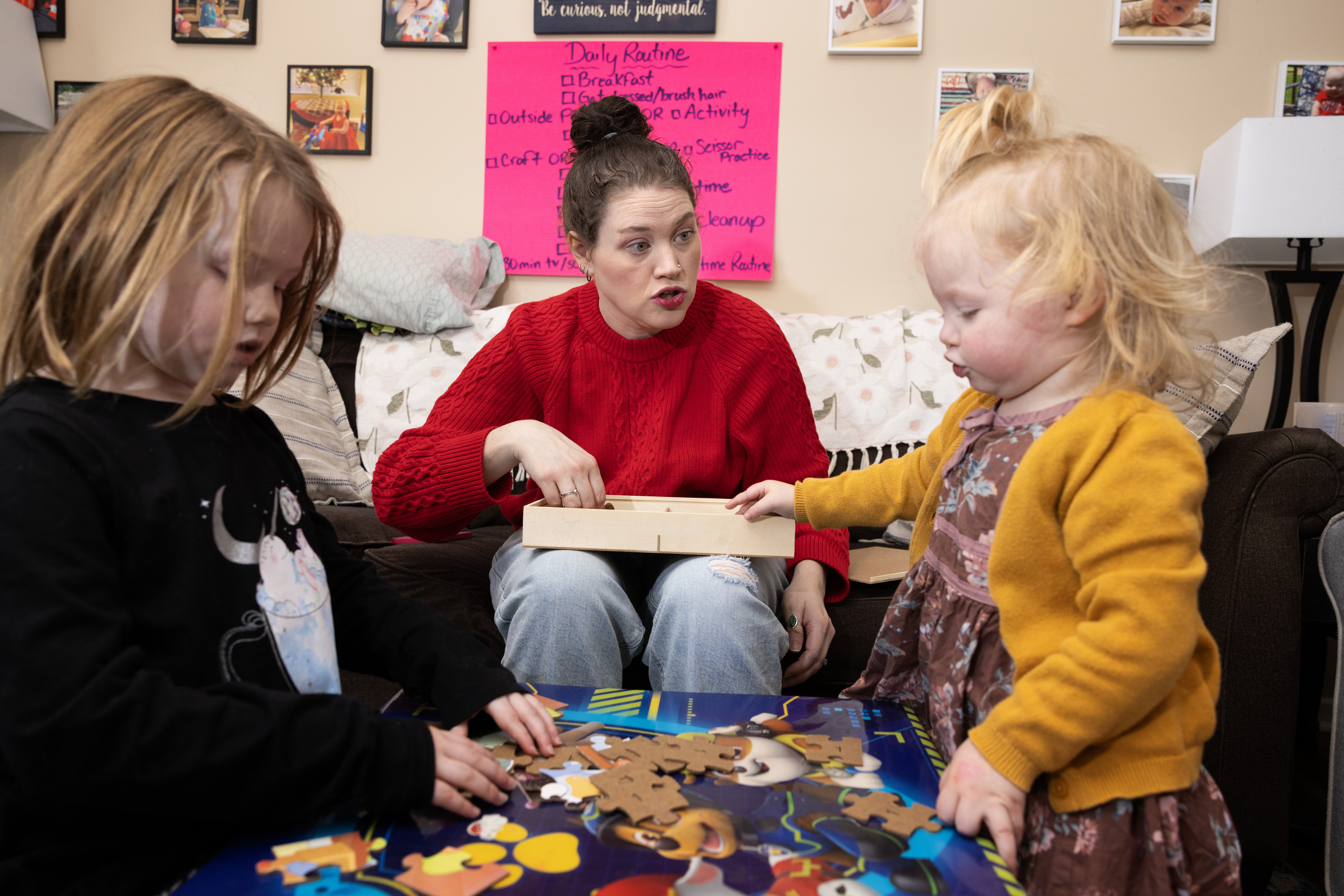
Malissie Plugge plays with her daughters, Margo, 5, left, and Violet, 2, at their Omaha home on Feb. 20. Photo by Rebecca S. Gratz for the Flatwater Free Press
The domino effect
Plugge and her husband both work as teachers, and their family has health insurance. She didn’t foresee any way that her own life could be directly affected by people losing coverage.
“As someone who's not on Medicaid, I'm like ‘Gosh, I hate everything that's going on,’ but I didn't expect to be personally impacted by it,” Plugge said.
Each state runs its own Medicaid program that is jointly funded by the state and the federal government. The mega bill, which Trump signed into law in July, will cut federal Medicaid spending by nearly $1 trillion over the next 10 years. Among other changes, the bill will also impose work requirements for enrollees and end eligibility for some immigrants, including refugees.
Nebraska will see $4 billion less in federal Medicaid funding over the decade, said Sarah Maresh, health care access program director at Nebraska Appleseed. Tens of thousands of Nebraskans are expected to lose their health care coverage, Maresh said, which will be a hard hit to the state’s health system.
“Not only is it going to hurt the individuals and the families who are not going to be able to access care …” Maresh said. “We're really concerned about the downstream effects as well.”
All five members of Nebraska’s congressional delegation voted for the bill. Rep. Don Bacon, a Republican representing Omaha, did not respond to a request for comment. Bacon had repeatedly expressed concerns about the steep cuts to Medicaid, but justified his vote in a statement at the time calling the tax provisions, which made permanent the tax cuts passed during Trump’s first term, “critical.”
Rep. Mike Flood, a Republican representing much of eastern Nebraska, declined to comment, but a spokesperson pointed to a column Flood wrote in 2025 pitching the reform as necessary to ensure Medicaid’s long-term viability.
“These reforms are designed to restore fiscal discipline, promote work, and empower states … They are not designed to affect our most vulnerable Americans who rely on Medicaid,” he wrote in the column.
New work requirements for Medicaid eligibility, which Nebraska will be the first state to implement, will also impact people working in child care, Maresh said.
“I'm thinking about child care providers, where a lot of those folks are self-employed, and how difficult it will be for them … to verify that they're meeting those hours to make sure they can get their health care coverage,” Maresh said.
Implementing federal work requirements will be a herculean effort for states, Maresh said, and she fears that many Nebraskans, including child care providers, will fall through the cracks and lose coverage in “mass numbers.”
Around 13% of child care workers in Nebraska reported that they use Medicaid in 2023, the most recent year data is available. That number was up from 11% in 2019.
And the portion of child care workers who reported using Medicaid is consistently higher than the general rate of all adults enrolled in Medicaid in Nebraska, which was 10% in 2023, according to Flatwater’s analysis of Census Bureau data.
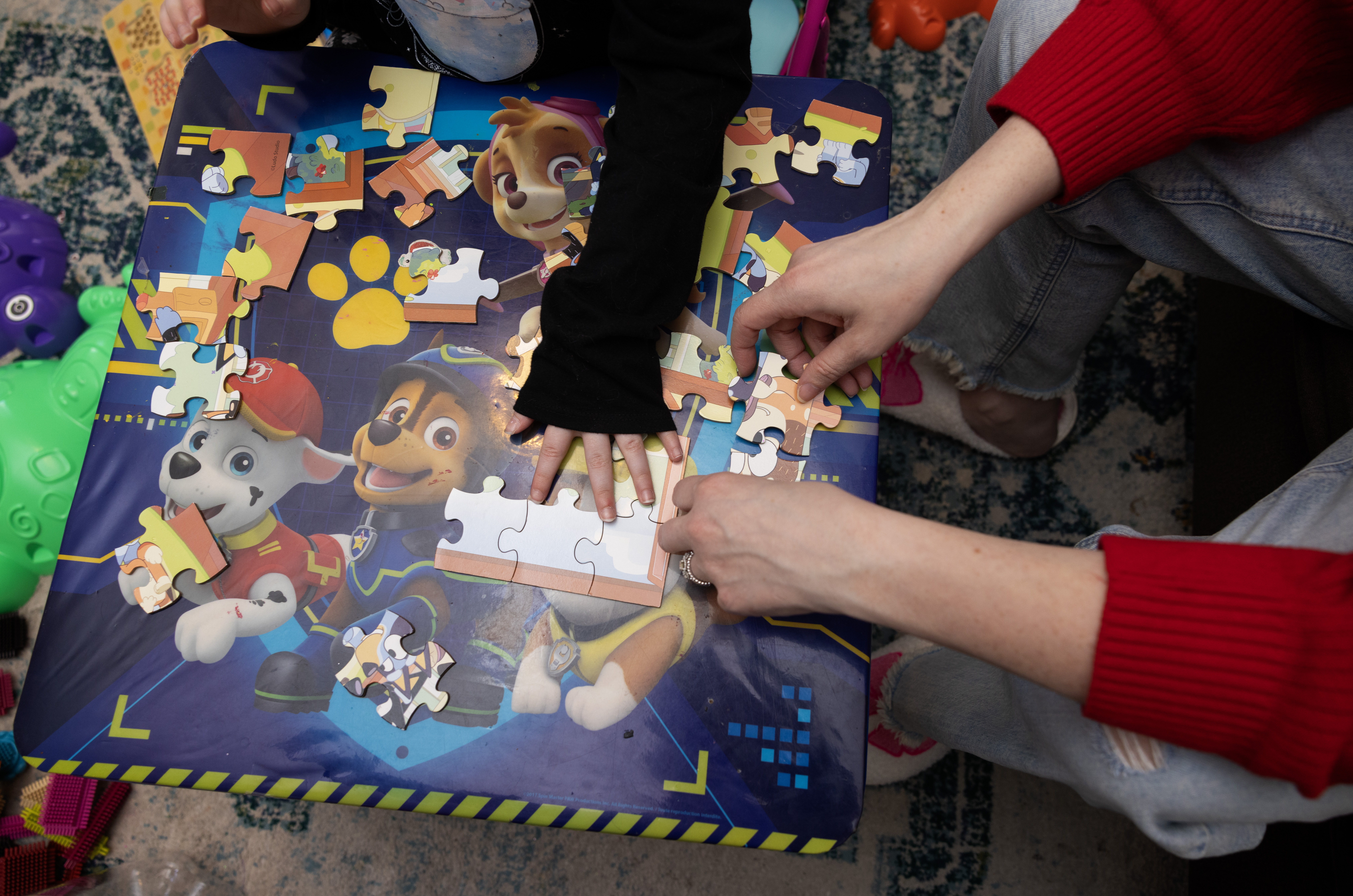
Malissie Plugge assembles a puzzle with her 5-year-old daughter, Margo. Photo by Rebecca S. Gratz for the Flatwater Free Press
Researchers at the University of Nebraska Medical Center College of Public Health’s Center for Health Policy estimated that more than 57,000 adult Nebraskans – or roughly 37% of adult Nebraskans enrolled in Medicaid in 2023 – would lose coverage.
If that estimate becomes reality, more than 650 child care workers may lose coverage.
Other child care providers will not directly lose their Medicaid coverage but may still be driven to leave the industry because a loved one has lost coverage.
The Plugges’ day care provider — who declined to be interviewed for this story — is part of what researchers call the “sandwich generation,” adults who have both children and elderly or disabled adults depending on them for care.
At least 1 in every 4 adults are part of that group, and that number will grow as the Baby Boomer generation continues aging, said Julie Kashen, director for women’s economic justice at the Century Foundation, a progressive think tank. Without Medicaid support paying for long-term care, people with adult dependents may also need to leave their jobs.
UNMC estimated that 1 in every 5 seniors could lose nursing home care due to both loss of coverage and anticipated nursing home closures.
And, as was the case with the Plugges’ provider, it can create a domino effect, Kashen said:
* Pulling home health care support from one woman led the day care to close;
* Multiple families are now losing child care;
* A parent from some of those families may have to drop out of the workforce if no alternative can be found.
“These Medicaid cuts, maybe they don't affect you directly, they are going to affect you in some way,” Kashen said.
Many of the biggest impacts of the cuts are still unknown, as states will need to budget to handle the loss of those federal funds. The Plugge family’s situation is a hint of what’s to come, Kashen said.
Adults won’t be the only ones impacted. About half of all Nebraskans enrolled in Medicaid are children — approximately 180,000 — according to the Nebraska Department of Health and Human Services.
“There are policy choices we can make that make children healthy and safe and nurtured. That's a choice we could be making,” Kashen said. “Instead, we are saying, ‘Let's make it harder. Let's make people less healthy.’ … All of these barriers are being put up when they should be being knocked down.”
A fragile system
The number of child care workers in Nebraska has been steadily decreasing. In 2019, the Census Bureau estimated that about 18,600 Nebraskans were working in child care. By 2023, that number dropped to about 13,300.
And as that number dropped, the proportion of those workers who are enrolled in Medicaid increased.
It’s already difficult for families in Nebraska to access child care, Gilliam said, and the main reason is that shrinking number of staff, often because they’re paid “so terribly.”
Child care has always been an underpaid profession, but the COVID-19 pandemic led to many other underpaid professions becoming better paying. Now, there’s not enough child care staff because they can find better wages doing “just about anything else,” Gilliam said.
The Buffett Early Childhood Institute estimates that nearly 4,500 children in the Omaha metro area alone need care that their families can’t access. That Omaha child care coverage gap equates to as much as $335 million in economic losses over 10 years, according to the Buffett report.
Gilliam knows a child care provider in central Nebraska who runs an in-home day care that cares for the children of teachers at the local public school.
She’s the teacher who makes seven other teachers possible, Gilliam said. There isn’t another child care provider in town, so some of those teachers wouldn’t be able to work without her.
She runs the day care at a loss, Gilliam says, because those teachers can afford to pay only so much.
“What she was describing to me was clearly an infrastructure role that she played for the public schools and … she's doing it as a failing business model that is subsidized on the goodwill and the fortunate existence of a husband who makes a decent living,” Gilliam said.
Places in Nebraska where child care providers and families are living at or near poverty will be hit hardest by the Medicaid cuts, Gilliam said, both because they are more likely to be enrolled in Medicaid and because there aren't enough providers to meet demand.
“This is not a robust system,” Gilliam said. “This is an incredibly fragile system that's already under a massive amount of strain. And this is yet another straw on a camel's back that's already breaking with the strain.”
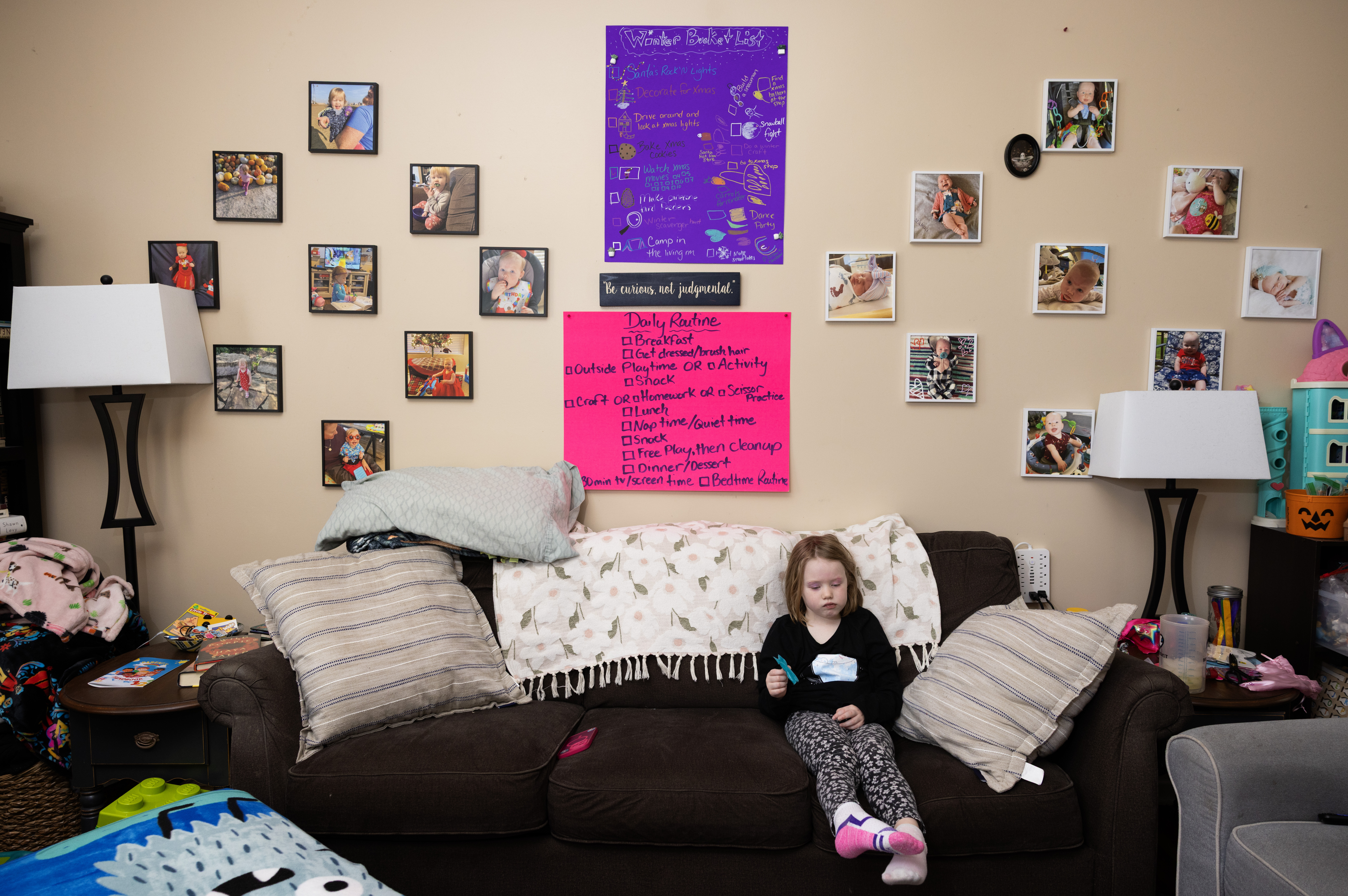
Margo Plugge, 5, eats a snack on the couch. Photo by Rebecca S. Gratz for the Flatwater Free Press
Losing the place and the people that her children loved was a major blow for the Plugges, not just emotionally, but financially.
She found a new day care for the girls, and negotiated the monthly rate down a few hundred dollars, but it still will cost the family $500 more every month. Finding that money in their already tight teachers’ budget is going to hurt.
“We don't eat out and we don't do a lot of shopping and all of those things, so it's like, what's left to cut?” Plugge said.
Plugge is relying on help from her mother-in-law to fill in the gaps and is counting down the days until summer break. Then Margo will start kindergarten in the fall, and they will only need to pay for Violet.
“Otherwise, I mean, I can't even conceptualize what I would do,” Plugge said.
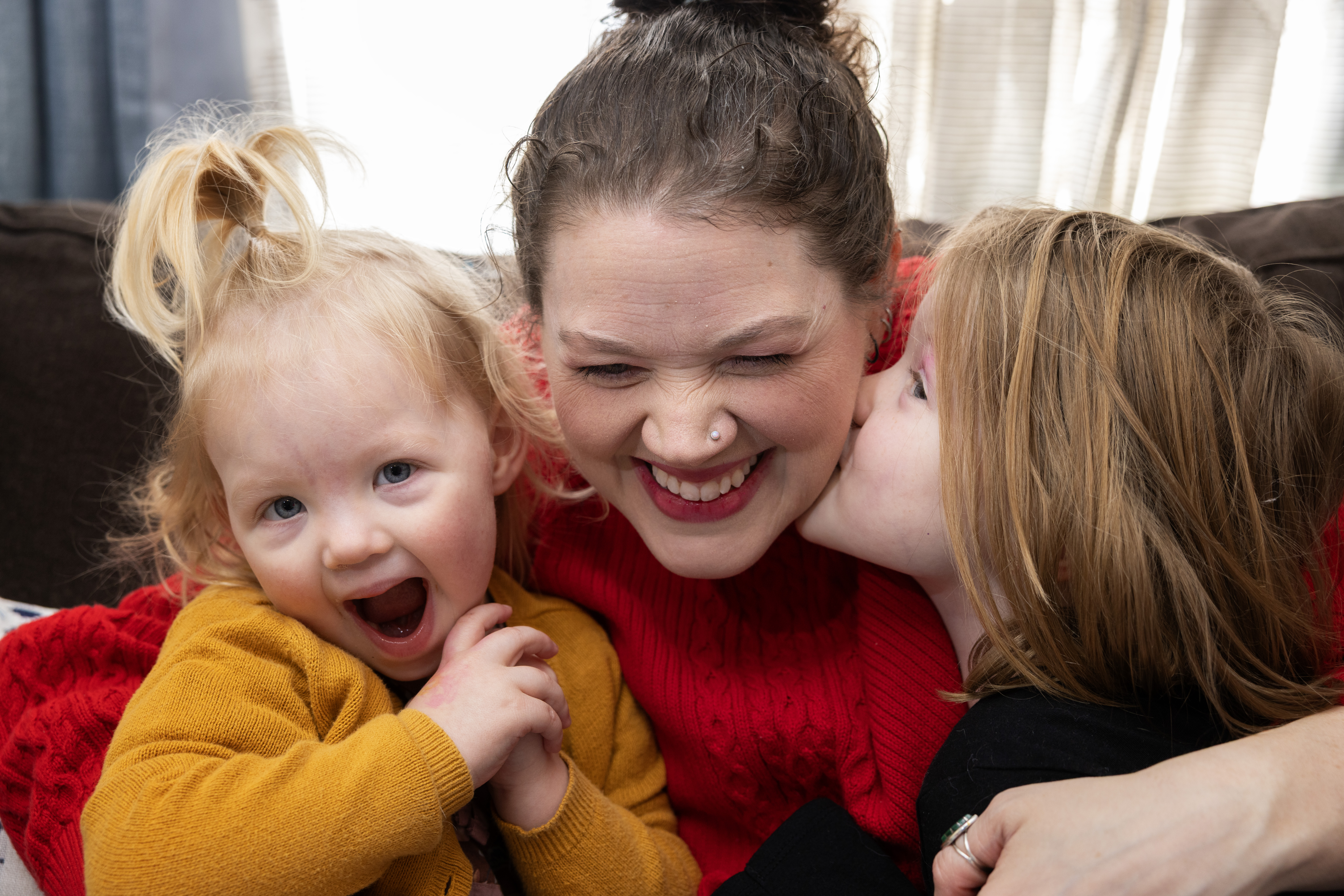
Malissie Plugge holds her daughters, Violet, 2, left, and Margo, 5. Photo by Rebecca S. Gratz for the Flatwater Free Press
The Flatwater Free Press is Nebraska’s first independent, nonprofit newsroom focused on investigations and feature stories that matter.